
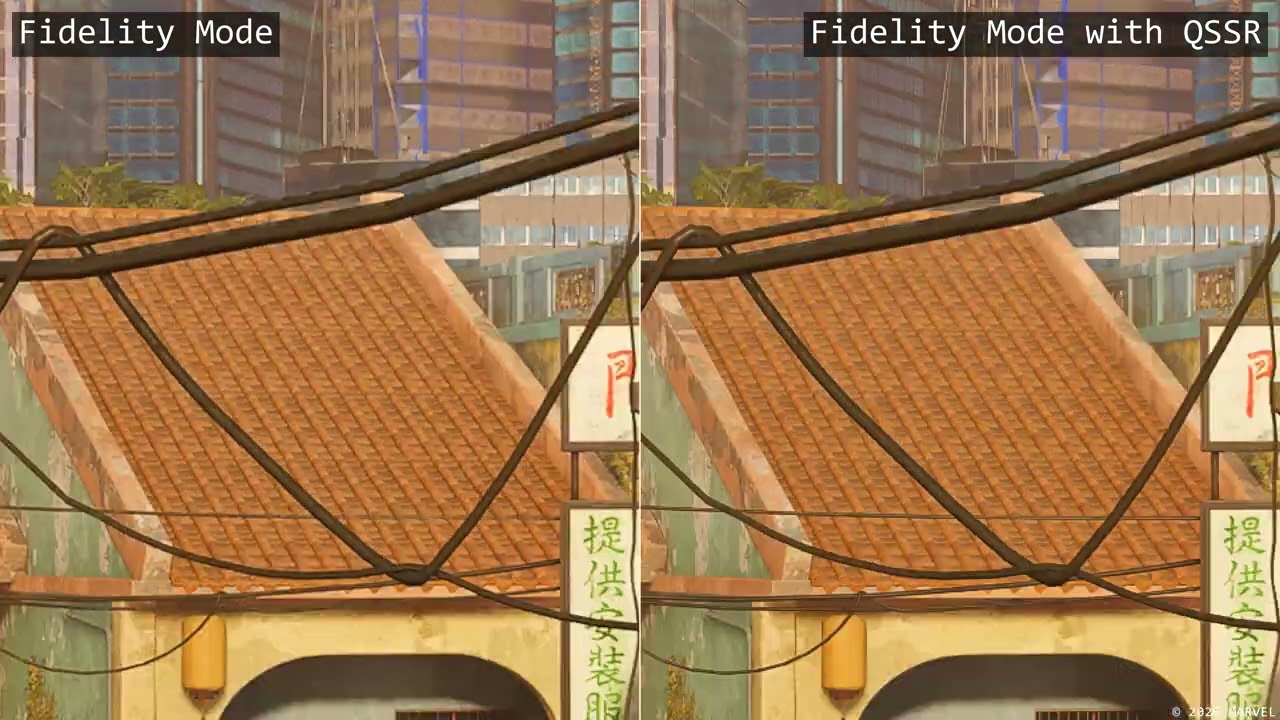
If you stuck with a base PS5 while Pro owners got PlayStation Spectral Super Resolution, October 1, 2026 is the day Sony answered the follow-up. Quick Spectral Super Resolution – QSSR – is a new AI upscaling library for the standard PS5, and Marvel’s Wolverine and Ghost of Yōtei are getting patches today that add it as a graphics option. Sony’s PlayStation Blog is clear that PSSR on PS5 Pro stays the gold standard. This is not a claim that base hardware suddenly matches Pro. It is a real bump in image detail and temporal stability for the console most people actually own.
PSSR rebuilds a lower-resolution render with a neural network so the final frame looks sharper and more stable than older temporal upscalers. On Pro that work rides dedicated machine-learning silicon – roughly 300 TOPS, per Digital Foundry – plus INT8-friendly math. The base PS5 does not have that kit, and until this week the official story was that full PSSR was too expensive to run there.
QSSR is the lighter path. Daniel Craig, principal engineer on Graphics R&D at SIE, says it comes out of Project Amethyst, Sony’s AI graphics collaboration with AMD. Two pieces matter for players: a streamlined neural network, and a hand-tuned implementation aimed at PS5’s GPU. Under the hood that means leaning on FP16 and packed math instead of Pro’s dedicated path. Same family of idea as PSSR – pixel-aware AI reconstruction instead of plain FSR-style or TAA mush – different performance budget.
| QSSR (base PS5) | PSSR (PS5 Pro) | |
|---|---|---|
| Hardware | Standard GPU (FP16 / packed math) | Dedicated ML silicon (~300 TOPS) |
| Typical target | Often ~1440p presentation | Often tuned toward 4K output |
| Cost (early DF notes) | ~1.5–1.8 ms (864p to 1440p); ~4.4 ms toward 2160p | Gold-standard path; lower cost at 4K on Pro |
| Role | Lighter AI upscaler for base owners | Sony’s stated gold standard on Pro |
Expect developers to aim more often at something like 1440p presentation on base hardware rather than treating 4K as the default the way Pro titles usually do. Digital Foundry’s early Wolverine testing put the cost around 1.5–1.8 ms reconstructing 864p to 1440p, versus roughly 4.4 ms pushing toward a 2160p output in fidelity mode. That is why “quick” is in the name. On Ghost of Yōtei, DF found QSSR running at roughly the same unlocked performance frame rate as the game’s existing FSR 3 path, which is the kind of trade that makes an optional toggle worth flipping.
Insomniac’s Marvel’s Wolverine and Sucker Punch’s Ghost of Yōtei are the launch pair. Both patches land today and expose QSSR as an additional graphics option on PS5 – not a forced swap, so you can compare it yourself. Ghost of Yōtei Complete Edition also hits the same day. Insomniac’s Mike Fitzgerald talks about clearer streets in Madripoor and Shinjuku; Sucker Punch’s Jasmin Patry highlights finer character and environment detail plus temporal stability that was not really on the table for base PS5 before. Soft edges under camera motion are where a lot of this generation’s software upscalers still look tired. QSSR is meant to calm that down without asking you to buy a second console.
Sony is offering the library broadly to PlayStation developers. Craig told Digital Foundry it is “fundamentally a drop-in replacement” for titles that already ship PSSR on Pro, with maybe a few days of retuning for things like texture streaming. First-party shops that already leaned on Pro features are probably early in line; some third parties will take longer or skip it. That is normal.
A lot of people skipped PS5 Pro on purpose – price, shelf space, or they just bought a base unit last year. PSSR made that choice feel like leaving image quality on the table every time a trailer called out Pro enhancements. QSSR closes part of that gap. It does not erase Pro’s dedicated ML hardware, higher sustained budgets, or the way Pro games are tuned to output 4K with PSSR. Sony said PSSR remains the gold standard, and the early DF notes back that up: cost and target resolution are different animals on base silicon.
What you do get is a better reconstruction path than the soft TAA / FSR 3 compromises that defined too many base-PS5 patches this generation. For someone who already owns Wolverine or Yōtei on a launch or slim PS5, that is a gratis graphics option from a game patch – no Pro tax required. For the rando still deciding whether Pro is worth it, QSSR makes “stay on base” a little less punishing on supported titles, which is healthy for the installed base even if Pro keeps the nicer image.
Download the Wolverine and Yōtei patches, flip QSSR on, and look at foliage, hair, and fine architecture under motion. If it sticks for you, good. If Pro still looks cleaner on the same TV, that is also fine – Sony already said as much. The bigger win is that AI upscaling is no longer a Pro-only story on PlayStation. That is the kind of platform catch-up base owners have been waiting on since PSSR shipped.
FAQ
What is QSSR?
Quick Spectral Super Resolution is Sony’s AI upscaling library for the standard PS5. It rebuilds a lower-res render with a lighter neural network so frames look sharper and more stable than older TAA / FSR-style paths – without Pro’s dedicated ML chip.
How does QSSR compare to PSSR?
Same family of idea, different budget. PSSR on PS5 Pro uses dedicated machine-learning silicon and stays Sony’s gold standard. QSSR runs on the base GPU with a streamlined network and hand-tuned path. Better for base owners than soft software upscalers; not a claim that it matches Pro.
Which games have QSSR today?
Marvel’s Wolverine and Ghost of Yōtei. Both got patches on October 1, 2026 that add QSSR as an optional graphics setting on PS5. Sony is offering the library to other PlayStation developers, so more titles should follow.
Does QSSR equal PS5 Pro?
No. Pro still has the dedicated ML hardware, higher sustained budgets, and PSSR-tuned 4K presentation. QSSR closes part of the image-quality gap on supported base-PS5 titles. It does not turn a base console into a Pro.