
The first thing people are going to argue about with The Legend of Zelda: Ocarina of Time on Switch 2 is the look. That is fair. Nintendo spent a lot of today’s 40th Anniversary Direct on gameplay, but the screenshots are doing most of the talking. This remake does not look like Breath of the Wild. It does not look like a straight photoreal upgrade of the Nintendo 64 models. It also does not look like the cel-shaded Wind Waker family.
I have a name for it: craft-style graphics.
Characters look like they were sculpted. Faces have a smooth, clay-like surface. Proportions stay slightly stylized, closer to a high-end figure than a live-action actor. Then you put those figures down in a world made of real materials. Wood grain. Packed dirt. Moss. Individual leaves. Stitching on a tunic so tight you can count the threads. Nintendo’s own press notes say the visuals were “completely overhauled down to the textures of each material.” That sentence is doing a lot of work, and the screenshots back it up.
Aonuma said during the Direct that there was a lot of discussion about how this remake should look. You can see why. Go too realistic on Link and you lose the fairy-tale shape of Ocarina. Go too cartoony and the new lighting, water, and foliage start to fight the characters. Craft style is the compromise that actually holds together: handmade people, photographed world.
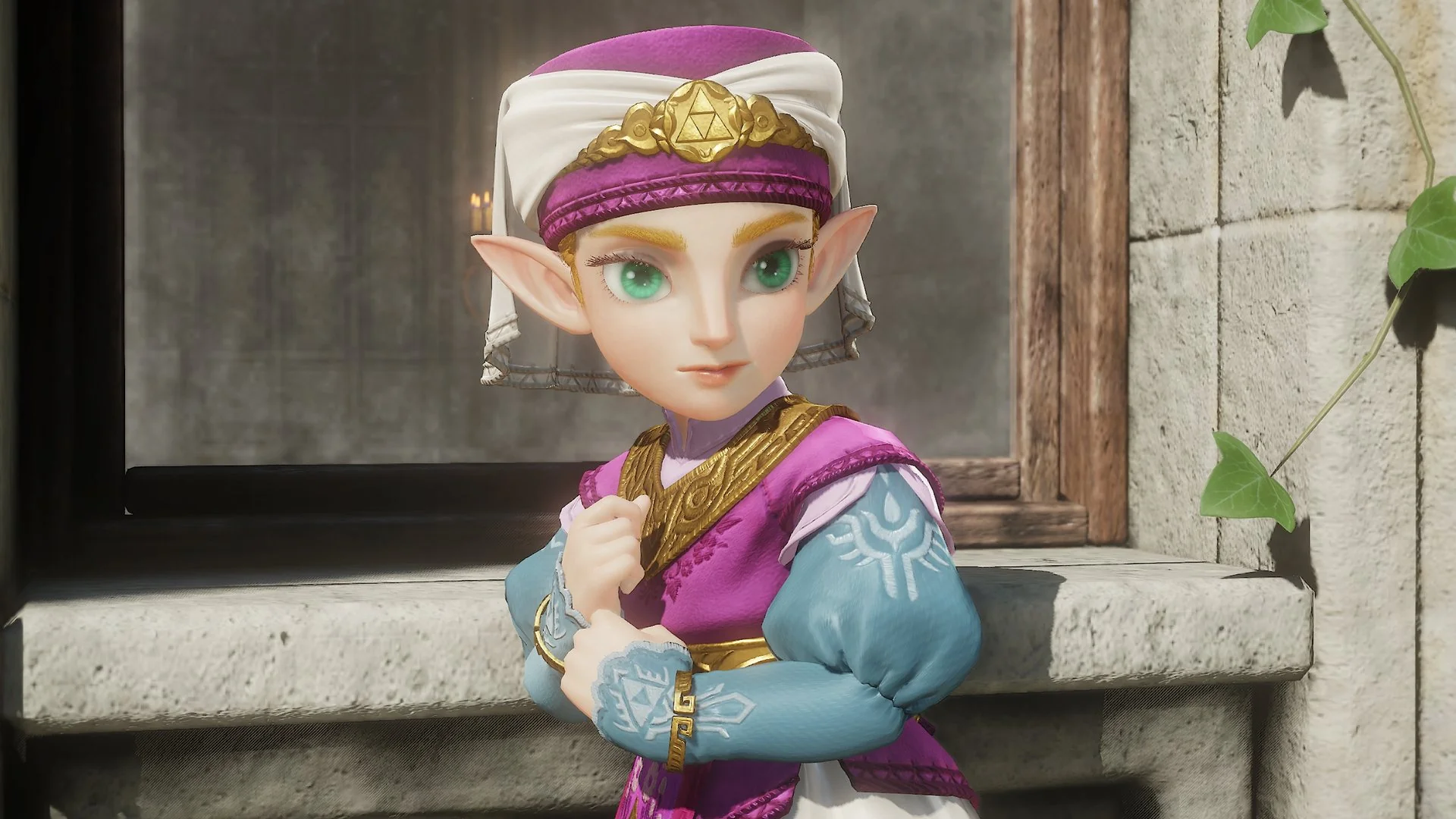
Young Zelda is the clearest example of the style. Clay-smooth skin, then fabric so detailed you can see the weave and the gold embroidery. Image: Nintendo
The characters look like they were made, not scanned
Young Zelda’s close-up is the screenshot I keep coming back to. Her skin is porcelain-smooth. The ears, the lashes, the slight catchlight in the green eyes all read as a sculpt. Then the costume takes over. The white headdress has a gauze edge. The magenta vest has a visible textile pattern. The gold Triforce circlet has weight and scratches. The blue sleeve is embroidered, not painted on. This is not “better polygons.” This is a costume department.
Adult Link’s hero shot in the Temple of Time does the same trick from farther away.
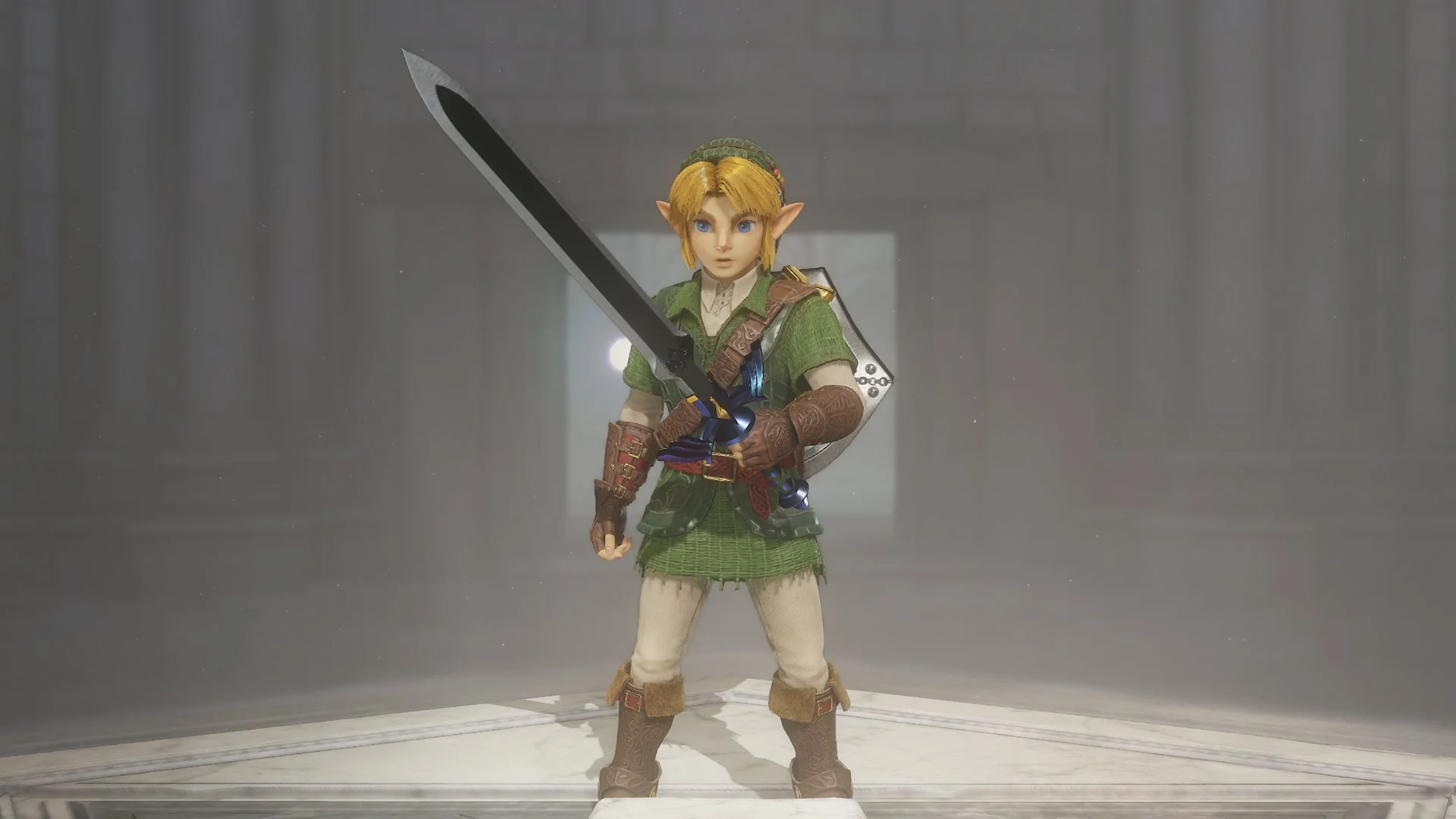
Adult Link’s tunic is woven, not smooth plastic. The leather bracers are tooled. The belt and boots have stitching. Image: Nintendo
The green tunic is a textile. You can see the under-layer at the skirt and the way the fabric hangs over the belt. The bracers have carved patterns. The Hylian Shield’s felt backing peeks out behind his shoulder. Navi is no longer a simple glowing pentagon. She is a tiny constructed fairy with translucent wings. Link still looks like Link, which is the hard part. The silhouette is the 1998 design. The surface is 2026.
Saria and young Link standing on the forest overlook make the character/environment split obvious in a single frame.
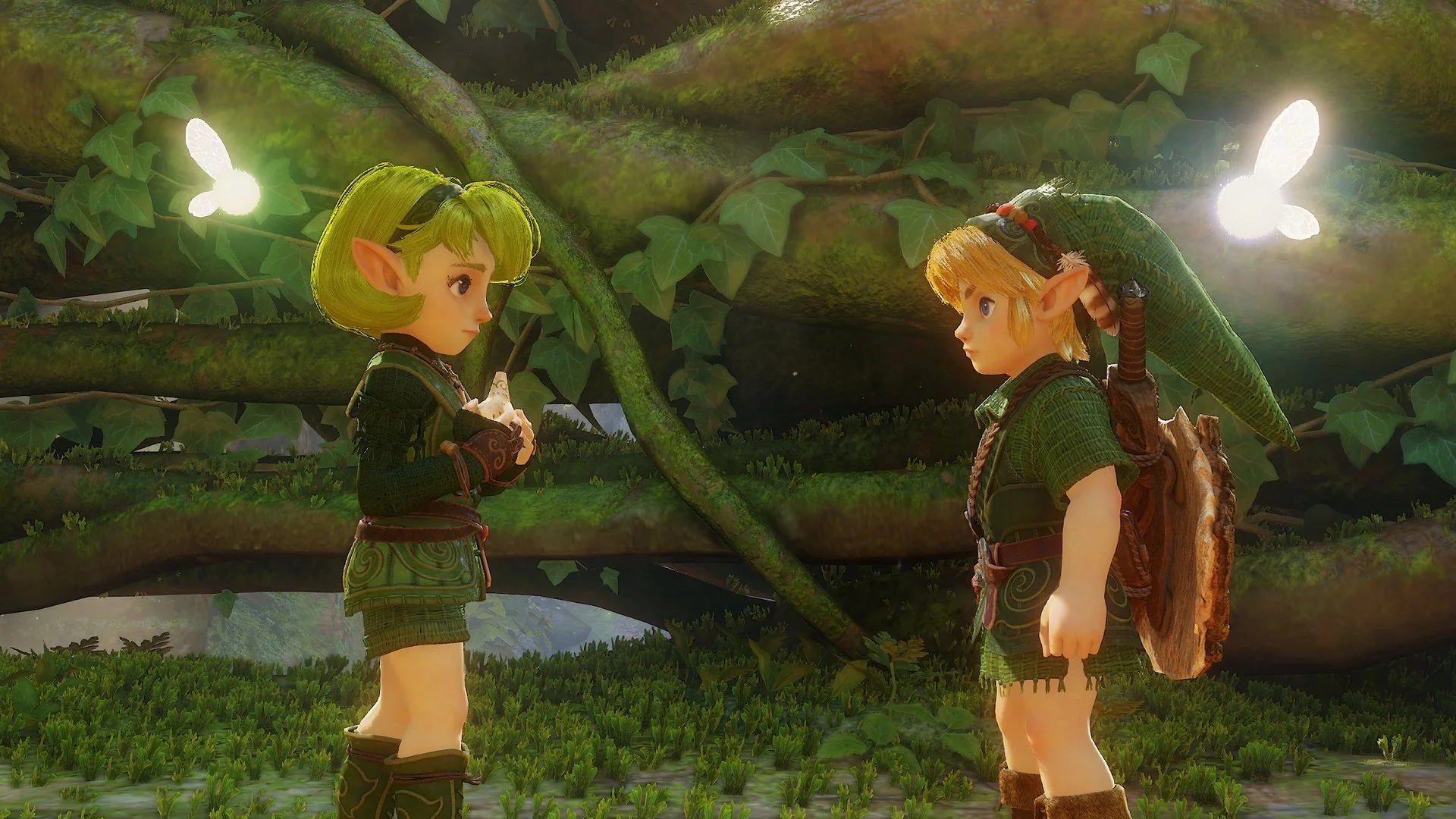
Saria and Link have that same crafted, slightly doll-like presence. The tree they are standing on does not. Image: Nintendo
Their tunics are knitted and stitched. Their faces stay in that clay register. Behind them, the branch is wet moss, bark, ivy, and dirt. If you cropped the characters out, you could almost mistake the background for a nature photograph with a painterly grade. If you cropped the background out, you would have two high-end stop-motion puppets. The style lives in that collision.
The world is wood, dirt, plants, and weather
Kokiri Forest is where the environmental work shows off. The original village was a handful of low-poly trees and a dirt path. The remake keeps the path, the stump houses, the Deku Flower lanterns, and the fireflies, then rebuilds every surface.
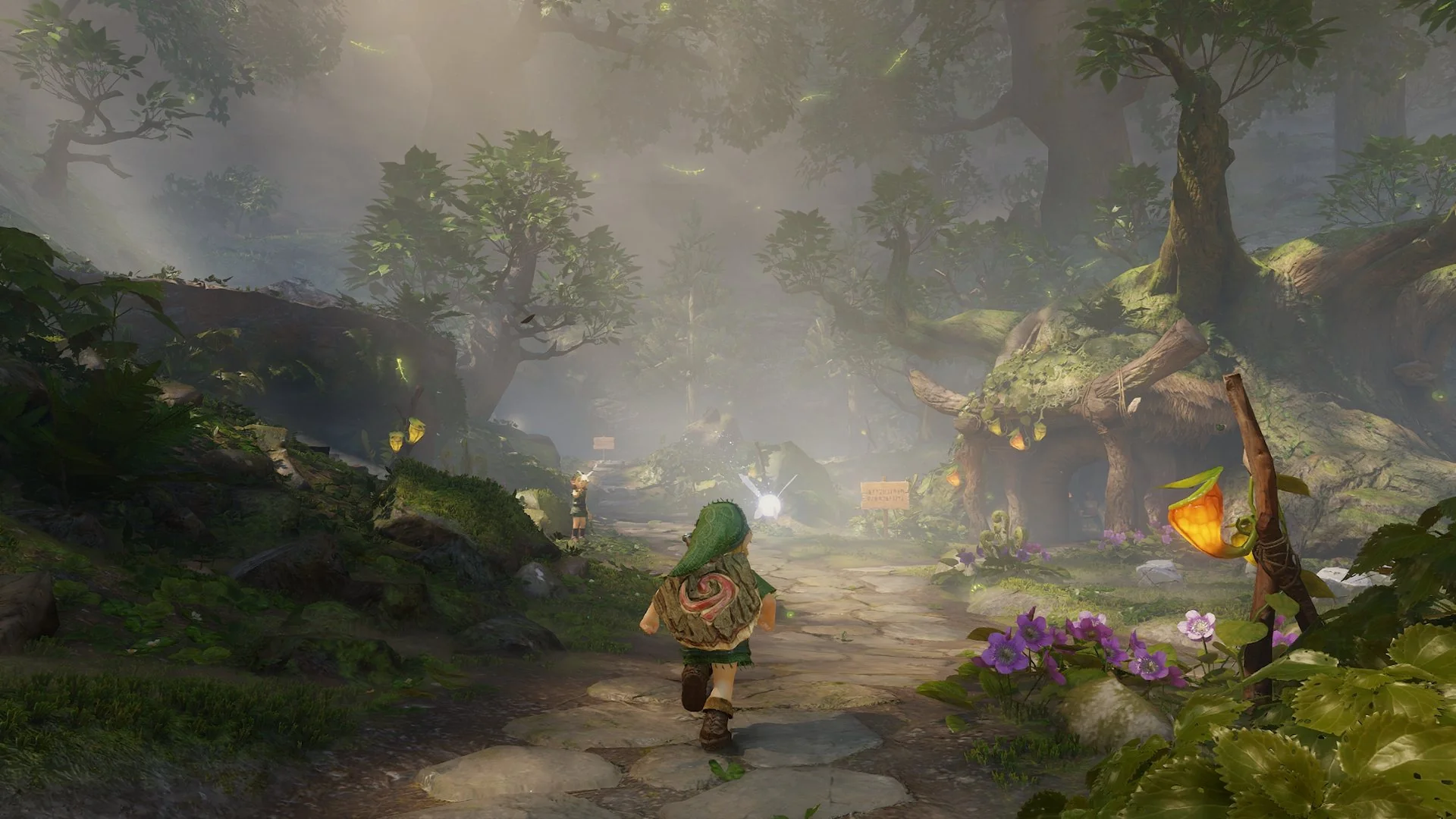
Kokiri Forest: stone, moss, leaf litter, hanging vines, and a stump house that looks grown rather than placed. Image: Nintendo
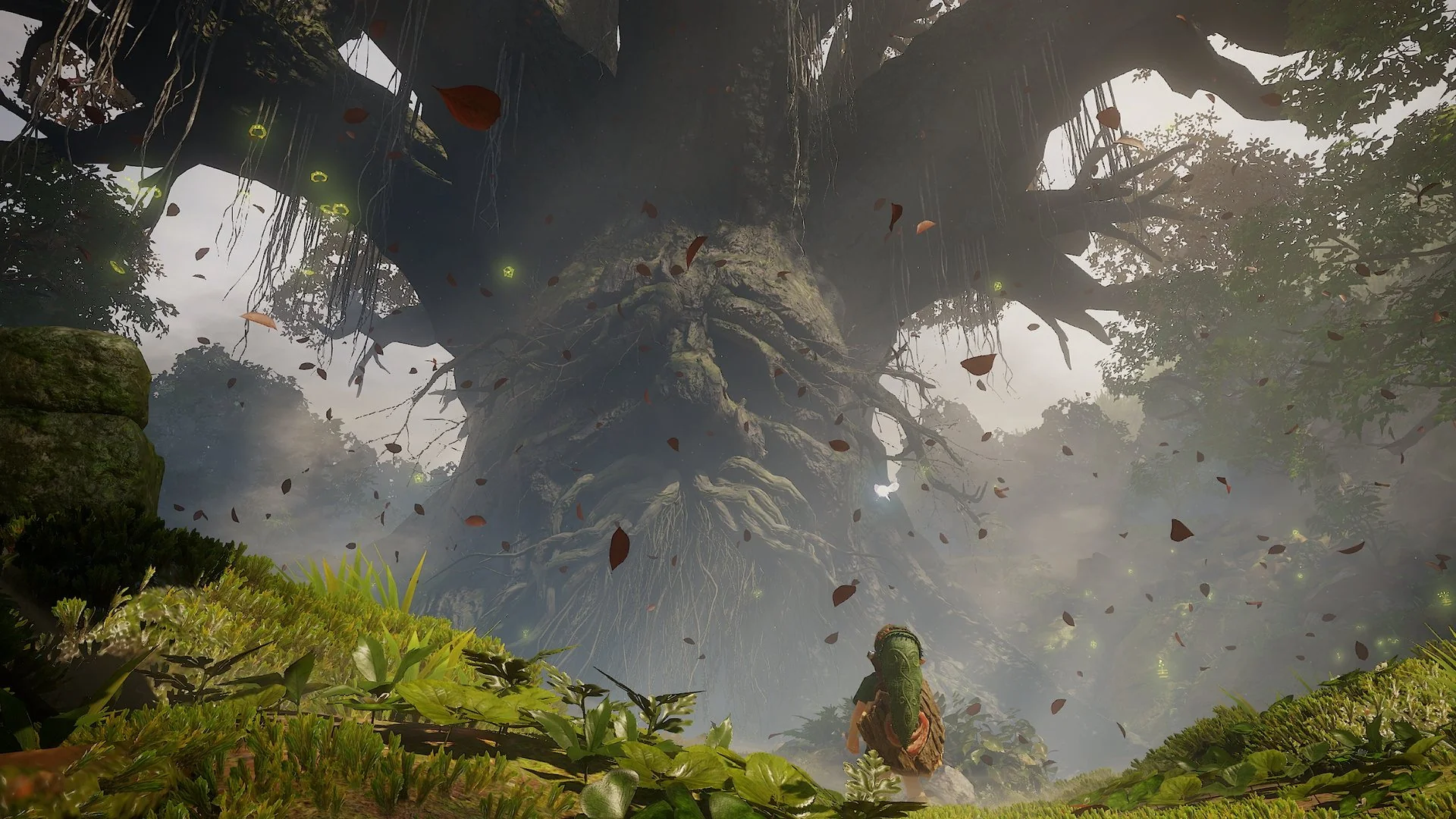
The Great Deku Tree is bark, hanging roots, moss, and weather. Link is tiny in front of it, which is the point. Image: Nintendo
Look at the right side of that forest shot. The house is a living stump with moss on the roof and wood that has been wet for a hundred years. The Deku Flower lamp in the foreground has a waxy, plant-like glow. Purple blossoms sit in real dirt, not a texture tile. Light shafts come through the canopy the way they do in a forest at 9 a.m., not the way a 1998 fog plane used to fake depth.
Then Nintendo points the camera at the Great Deku Tree, and the “real materials” brief goes as far as it can go. This is not a painted backdrop with a face mapped on. The roots have dirt in the creases. Vines hang in front of the camera. Leaves are actually falling. The face is still the Deku Tree, just carved into a tree that looks like it could exist. Craft style again: a storybook character, a physical object.
Even the weird characters get the sculpt treatment
Darunia is the test. If the style only works on pretty Hylians, it is not a style, it is a beauty pass. The Zora prince on the other side of the map goes the opposite direction: smooth, wet, almost glass.
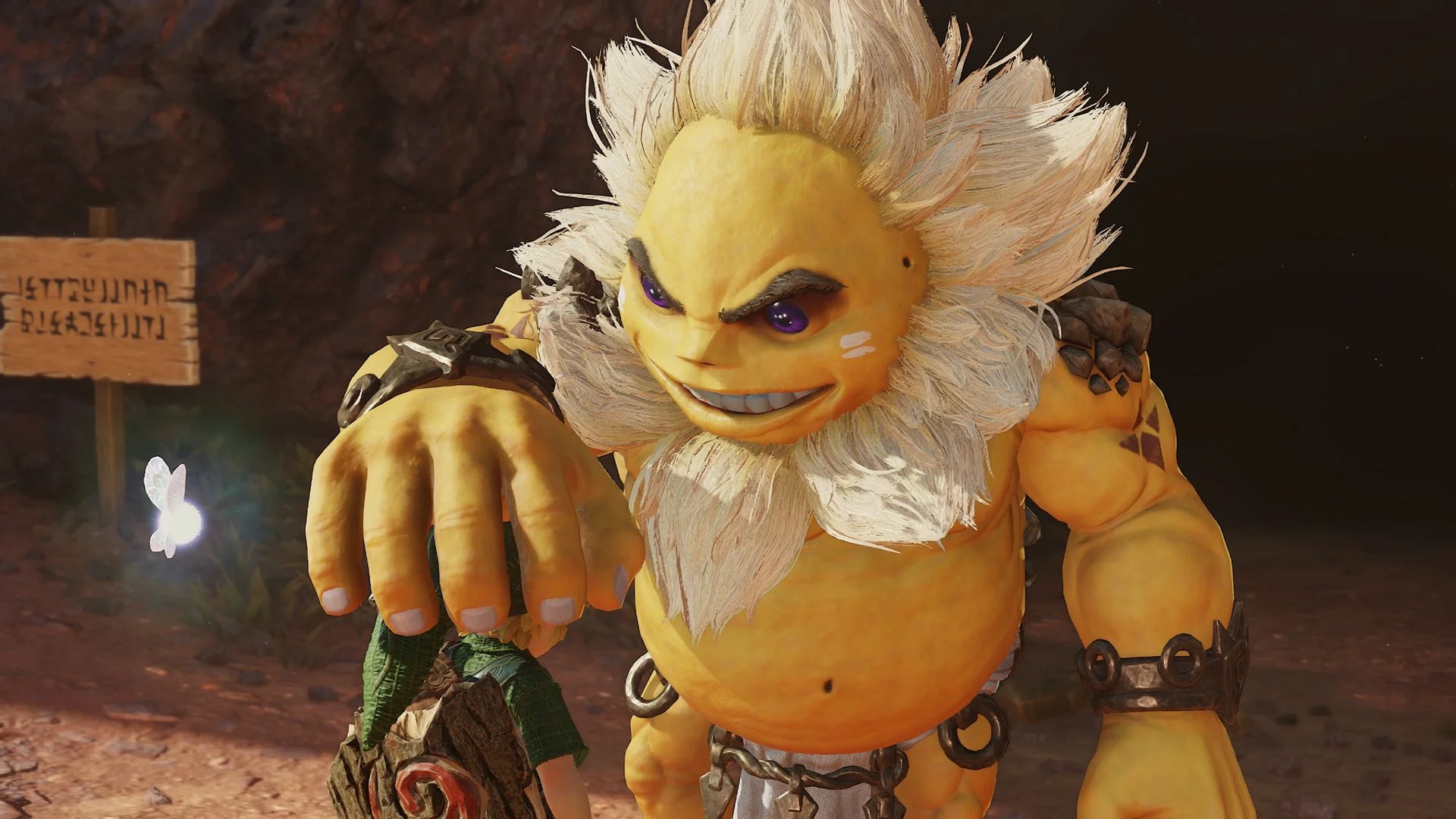
Darunia’s skin reads like fired clay or packed earth, with hair that looks spun rather than simulated. Image: Nintendo
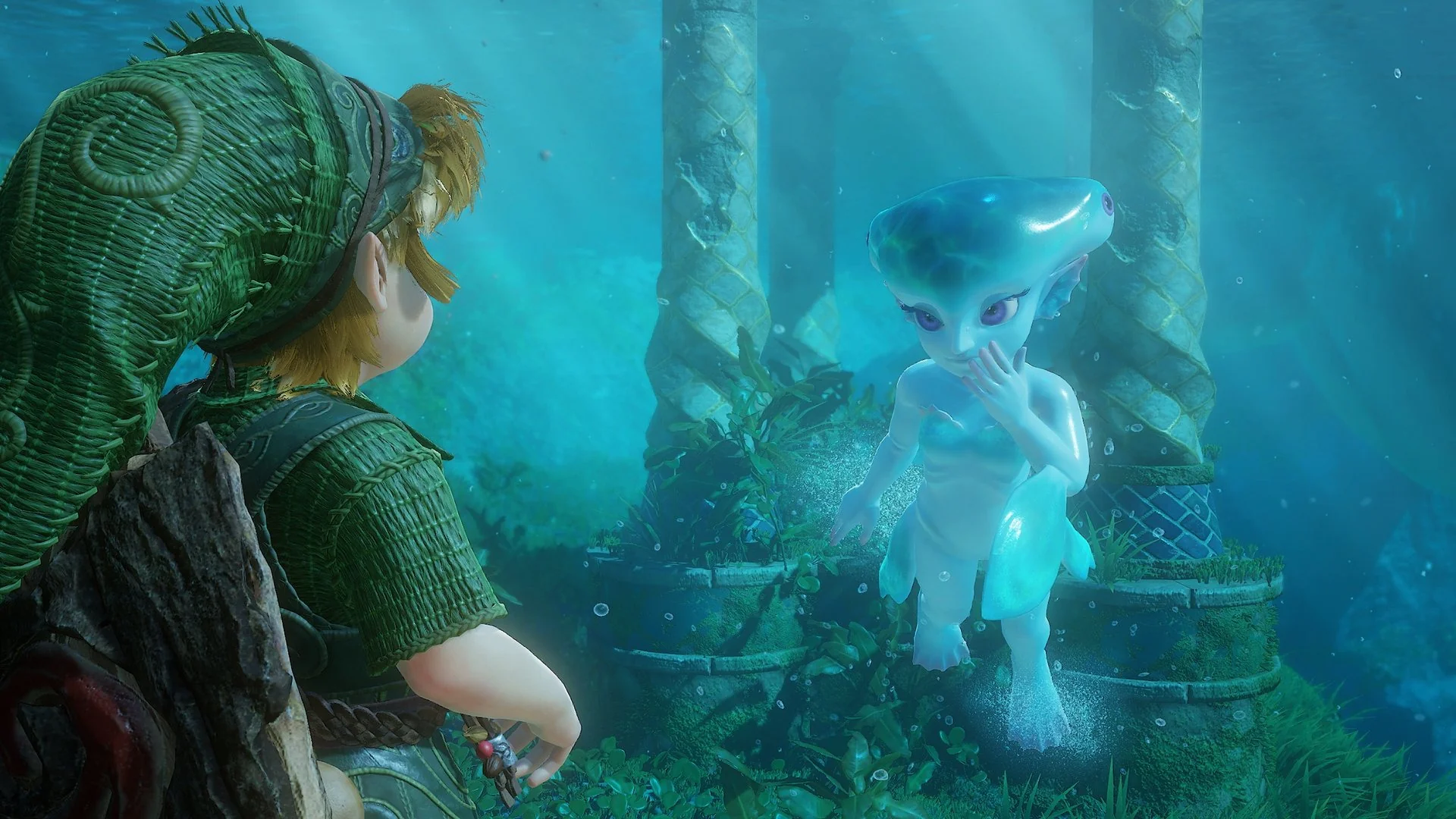
The Zora is a different material again: translucent, wet, and still sculpted. Link’s hat in the foreground is a basket weave. Image: Nintendo
Darunia’s body has the volume of a clay sculpture. The hair and beard have a fibrous, almost wool quality. The metal rings, the rock shoulder, the painted diamonds on his arm all sit on that surface instead of floating as separate effects. He is still the loud Goron from 1998. He just looks like someone built him in a workshop and set him in a canyon.
The Zora shot is also a close-up of Link’s Kokiri cap, and it might be the most “craft” image in the set. That hat is woven. Not a green cone with a noise texture. Woven, with a leather strap, a braid at the neck, and a wooden shield slung over a stitched strap. Nintendo said “textures of each material.” They meant it.
Sheik is the adult version of the same idea. Wraps, embroidery, metal, and hair that has weight.
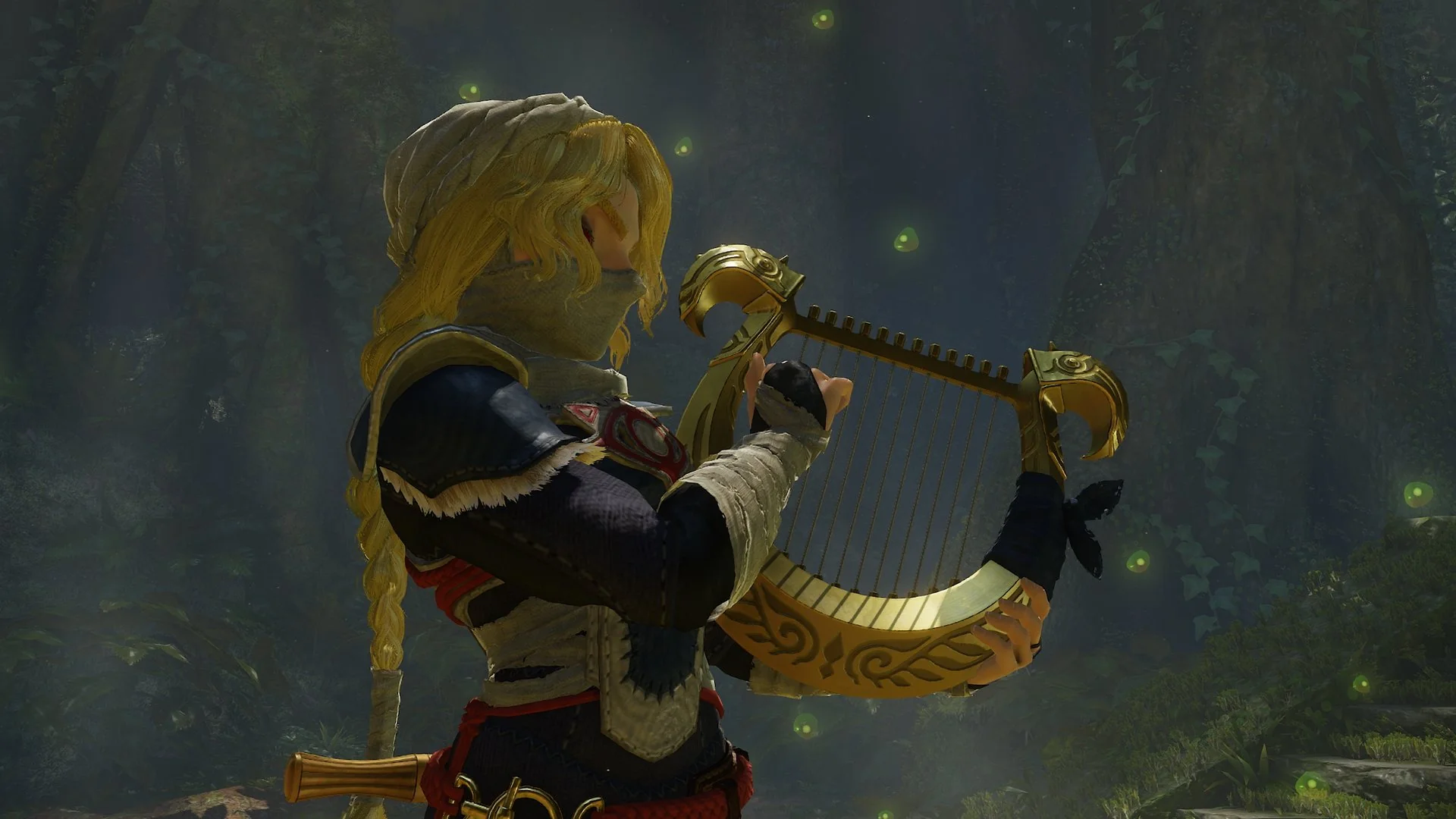
Sheik’s wraps, braid, and harp are all material studies. The forest behind is plants and light, not a stage flat. Image: Nintendo
Animals and steel get the same rules
Epona is not a cartoon horse and not a nature-documentary horse. She is in between, which is the whole thesis.
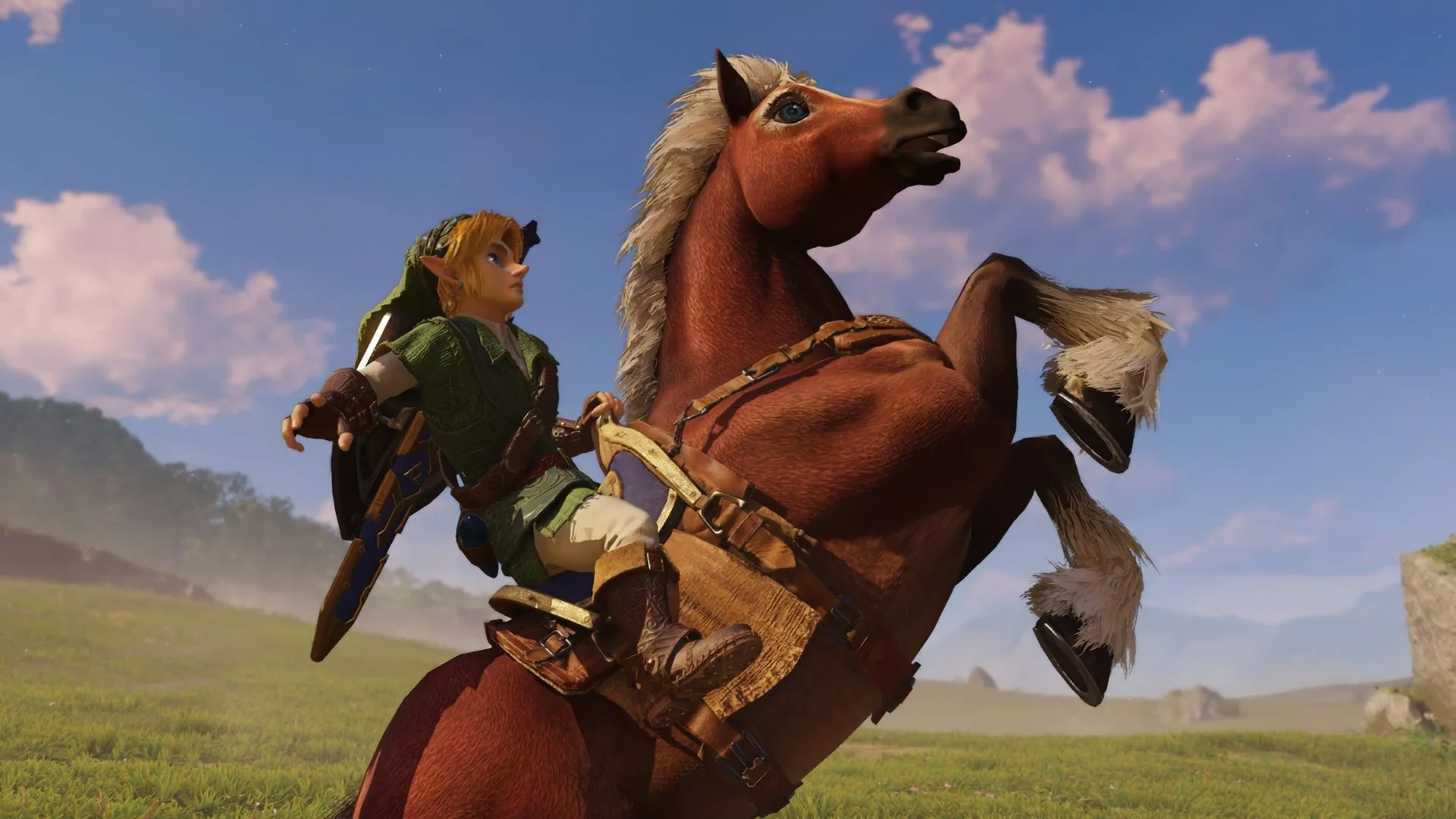
Epona’s coat, mane, and leather tack have the same “real materials, crafted subject” split as the human characters. Image: Nintendo
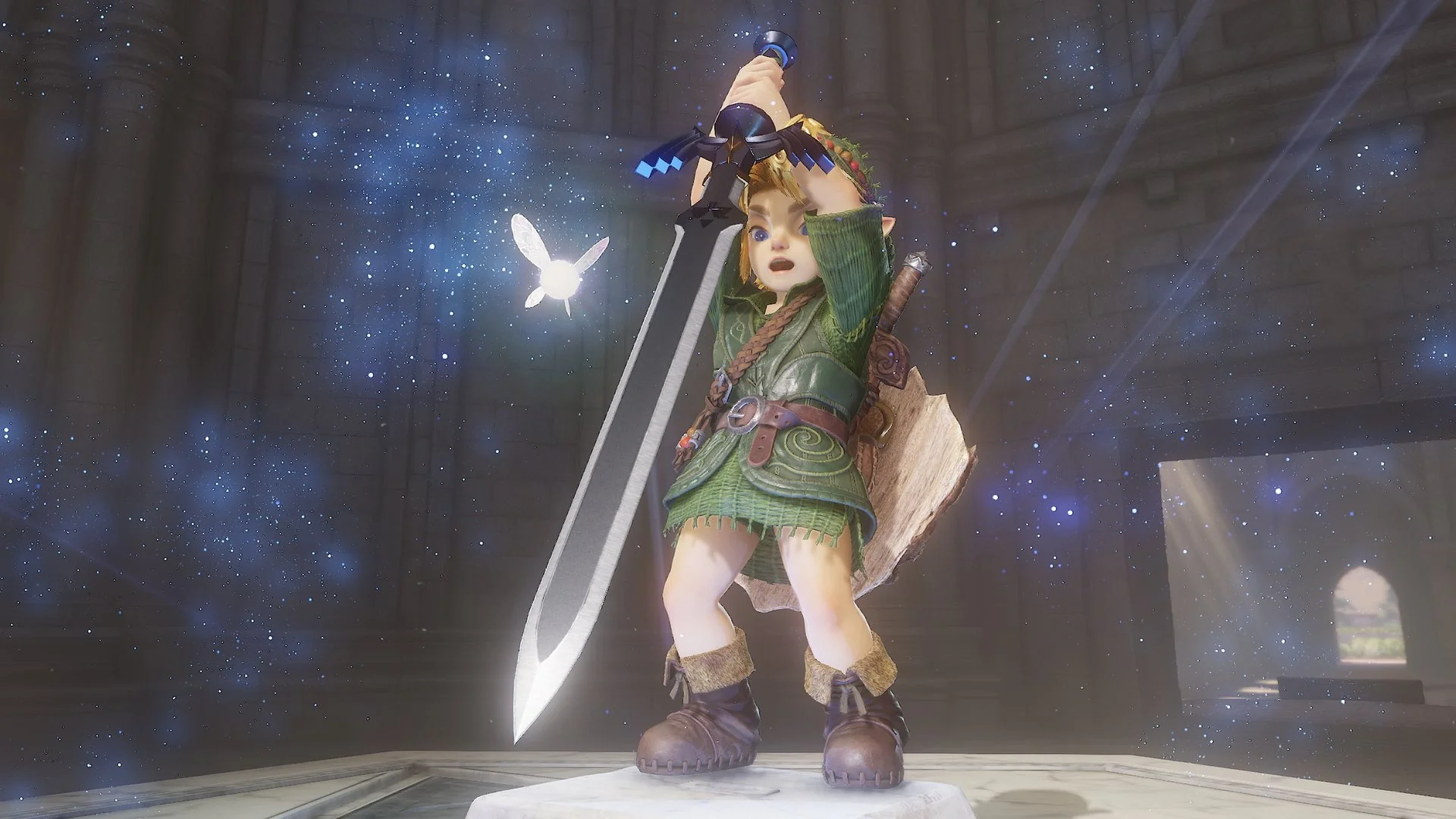
The Master Sword has a real edge and a real scabbard wrap. The tunic still shows its weave under the bloom of the cutscene lighting. Image: Nintendo
The saddle leather is worn. The buckles are metal. The grass has individual blades catching the light. Link’s tunic still looks knitted while he is in motion. That last point matters. A lot of remakes look great in a posed screenshot and turn to plastic as soon as a character runs. The Direct footage, and these stills, suggest the materials hold up when Link is actually doing something.
Young Link pulling the Master Sword is the other end of the material list: steel, stone, and magic. The blade has a bevel. The hilt wrap is fabric. The Temple of Time’s stone is stained and lit like a real interior, with dust in the light. Navi is there as a constructed object, not a UI diamond. If you have only seen the N64 version, this is the same pose you remember. It just finally has surfaces.
Why this look is a better fit than photoreal
Ocarina of Time was never a realistic game. It was a fable with a sword. The original got away with marble-smooth characters because the whole world was marble-smooth. The danger in a 2026 remake is that the world gets physically convincing while Link turns into an uncanny action-figure in a photograph.
Craft style dodges that. Characters stay slightly handmade, so they still belong in a legend. Environments go as far into wood, soil, water, and cloth as Switch 2 will allow, so the places feel like places. The two layers share a lighting model and a color grade, which is why Saria can stand on a photoreal branch without looking pasted on.
It also gives Nintendo a way to keep the original character designs. Young Link is still short, big-headed, and green. Zelda is still a storybook princess. Darunia is still a walking boulder with a grin. Nobody got “realistic proportions.” They got realistic stuff: thread, bark, leather, moss, steel.
That is a more interesting choice than another open-world Zelda look-alike, and it is a more interesting choice than a pure nostalgia filter. Whether the whole game holds that standard in motion, in every dungeon, at night, in the rain, is the question for November 5. Based on what Nintendo put in front of cameras today, the brief is already visible:
Sculpt the people. Photograph the world. Let the materials do the talking.
The Legend of Zelda: Ocarina of Time arrives on Nintendo Switch 2 on November 5, 2026. Digital is $59.99, physical is $69.99. For the date, price, and anniversary hardware, see the Direct recap. For jump, camera, and the rest of the control updates, see the gameplay breakdown.