
Here are the Nintendo Wii specs, starting with the one most people search for: the original console weighs about 1.2 kg, or 2.65 pounds. Nintendo launched it in the United States on November 19, 2006, at $249.99 with Wii Sports in the box, and November 19, 2026 marks 20 years since that US launch.
The original model stands 44 mm wide, 157 mm tall and 215.4 mm deep, excluding protrusions. That is 1.73 x 6.18 x 8.48 inches, width by height by depth. The table below covers the official size, weight, CPU, memory, ports and the rest of the hardware.
| Spec | Details |
|---|---|
| Weight | About 1.2 kg (2.65 pounds) |
| Dimensions (standing, W x H x D) | 44 x 157 x 215.4 mm (1.73 x 6.18 x 8.48 inches), excluding protrusions |
| Height | 157 mm (6.18 inches) standing; 44 mm (1.73 inches) lying flat |
| CPU | IBM PowerPC (codename Broadway), jointly developed with IBM, 729 MHz |
| GPU | Hollywood system LSI, developed with ATI |
| RAM | 88MB total: 24MB internal memory plus 64MB GDDR3 |
| Storage | 512MB internal flash memory, plus an SD card slot |
| Media | Slot-loading drive for 12 cm Wii discs (single or dual layer) and 8 cm GameCube discs (original model) |
| Ports | 2 USB 2.0, SD card slot, AV Multi-out, sensor bar connector, 4 GameCube controller ports, 2 GameCube memory card slots |
| Wireless | Built-in IEEE 802.11b/g Wi-Fi, Bluetooth for Wii Remotes, optional USB LAN adapter |
| Video out | AV Multi-out for composite, S-Video or component; no HDMI |
| Power | Official Wii AC adapter, 12 V / 3.7 A |
| US launch | November 19, 2006, $249.99 |
How much does a Wii weigh
The original Wii (model RVL-001) weighs about 1.2 kg, which is 2.65 pounds. The included vertical stand is a separate piece and is not part of the console weight.
Wii size and dimensions
Standing in its usual upright stance, the Wii measures 44 mm wide, 157 mm tall and 215.4 mm deep, excluding protrusions.
In inches, that is 1.73 inches wide, 6.18 inches tall and 8.48 inches deep. If you are asking how tall a Wii is, the standing answer is 157 mm, or 6.18 inches. Lay the same console flat and the thin 44 mm edge becomes the height, while 157 mm becomes the width and 215.4 mm stays the depth. The official stand measures 55.4 mm wide, 42 mm tall and 225.6 mm deep, excluding protrusions.

CPU, GPU and memory
The CPU is an IBM PowerPC chip codenamed Broadway, jointly developed with IBM on a 90 nm SOI CMOS process. Nintendo's developer documentation puts the clock at 729 MHz.
Graphics and much of the system logic sit in the Hollywood system LSI, developed with ATI. Per Nintendo's developer documentation, that chip holds 24MB of internal main memory, with another 64MB of GDDR3 attached as external main memory, for 88MB of RAM in total. The console also has 512MB of internal flash storage for channels, save data and downloaded software, plus a front SD card slot.
Ports and connections
On the original Wii, the front edge has an SD card slot. The top of a standing unit (the side that faces up when the console is vertical) has four GameCube controller ports and two GameCube memory card slots. The back has two USB 2.0 ports, the sensor bar connector, the AV Multi-out, and the AC adapter jack.
The AV Multi-out is the only video path. The pack-in cable is standard composite, and official options add S-Video or component. There is no HDMI, so a modern TV usually needs an adapter or a scaler. If you are already routing older consoles through a scaler, the same path works here; we walk through composite and component on a modern TV in a separate guide.
Networking is built-in IEEE 802.11b/g Wi-Fi. Wired Ethernet is not built in; it takes an official USB LAN adapter. The system can also talk wirelessly to a Nintendo DS or DSi, a feature used by a handful of games and channels at the time.
WiiConnect24, which could pull news, forecasts and messages while the console sat idle, ended on June 27, 2013. Nintendo Wi-Fi Connection, the online play service for many Wii and DS games, ended on May 20, 2014. The Wii Shop Channel, home to Virtual Console and WiiWare, closed on January 30, 2019, after March 26, 2018, was the last day to add Wii Points.
Wii Remote and Nunchuk size and specs
The Wii Remote measures 36.2 mm wide, 148 mm tall and 30.8 mm thick, excluding protrusions. It is a Bluetooth controller with a three-axis motion sensor, a speaker, rumble, a pointing sensor, and an expansion port on the bottom. The buttons are Power, A, B, the + Control Pad, Minus, Plus, Home, 1 and 2. Up to four remotes can be connected at once. Nintendo rates the pointer for use within 5 meters of the screen, and the original fact sheet put the wireless range at 10 meters from the console. Nintendo lists the remote's weight as about 133 g with the strap, without batteries.
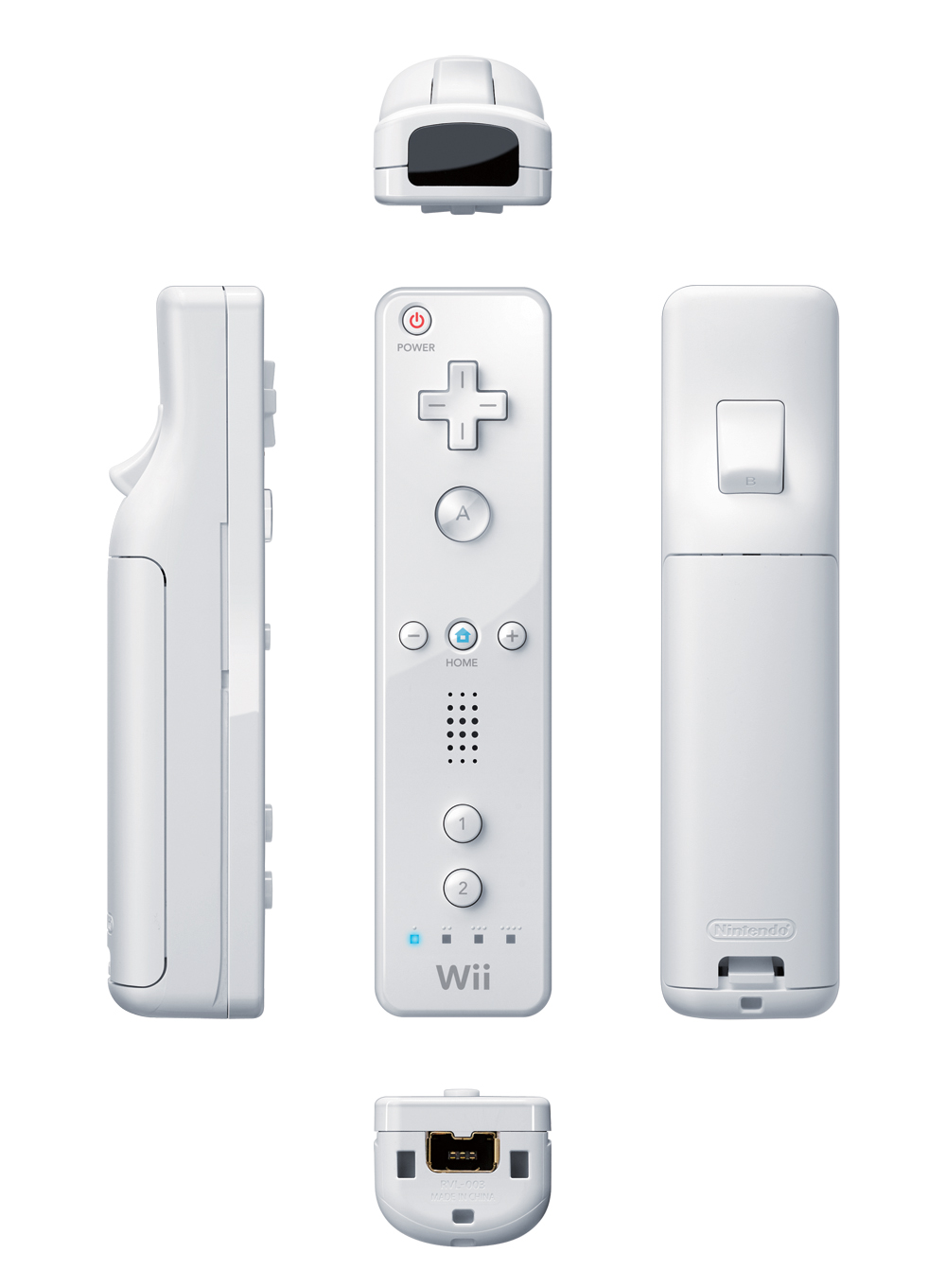
The Nunchuk, which plugs into that expansion port, measures 38.2 mm wide, 113 mm tall and 37.5 mm thick, excluding protrusions. It adds an analog stick, C and Z buttons, and its own three-axis motion sensor. Wii MotionPlus later clipped onto the remote for extra motion precision, and Wii Remote Plus builds that sensor into the remote itself.
Wii discs and GameCube backward compatibility
The slot-loading drive takes 12 cm Wii optical discs, single or dual layer, and, on the original model, 8 cm GameCube discs. It does not play CDs or DVDs.
The original Wii (RVL-001) is backward compatible with GameCube software, GameCube controllers and GameCube memory cards. Nintendo's official exceptions are the GameCube modem adapter, broadband adapter, Game Boy Player, AV cable and AC adapter. If you have an original white or later black RVL-001, those four controller ports and two memory card slots are the giveaway.
The 2011 Wii Family Edition (RVL-101) keeps the same cabinet dimensions but is meant to sit horizontally, and it drops GameCube disc, controller and memory card support. The same is true of the later Wii Mini. The Wii U is the successor, and it plays 12 cm Wii discs, but it is a different console with its own size, weight and ports.
Wii Mini and Wii Family Edition
The Wii Mini (RVL-201) is the most cut-down member of the family. Nintendo's support page says it is designed to sit horizontally, has no online features, includes only a single USB port, has no SD card slot, and cannot use GameCube discs or GameCube accessories. It still plays Wii discs and works with most Wii Remotes and Nunchuks.
The Family Edition sits between the original and the Mini: same size as the launch Wii, no GameCube compatibility, and a horizontal stance. If you need GameCube disc playback or the four GameCube controller ports, you want an original RVL-001.
Nintendo last reported lifetime Wii hardware sales of 101.63 million units worldwide, as of March 31, 2016, in its fiscal 2016 results. The current dedicated-hardware sales table no longer lists the Wii, so that is the last official total.